Chemical Incident Response Dossier Services
Chemical incidents can happen unexpectedly and have serious consequences for people, property, production and the environment. Without a response scenario and adequate emergency resources, a business may be caught off guard in the first few minutes, allowing the impact to spread further. Using a chemical incident response dossier service helps businesses proactively identify risks, develop response plans and minimize damage when an incident occurs.
>>> If your business needs advice on or assistance with a chemical incident response dossier, contact us directly via Zalo/Hotline: 0938.857.768 or CLICK THE CONSULTATION BOX for prompt support!

Article contents:
1. What is a chemical incident response dossier service?
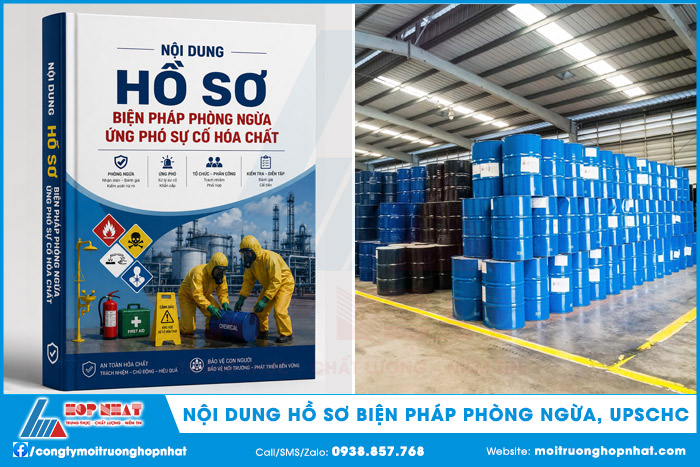
A chemical incident response dossier service is a consulting service that helps businesses develop a set of documents for preventing and handling situations that may arise during the production, use, storage, trading or transport of chemicals. The dossier clearly identifies risks such as leaks, spills, fires and explosions, toxic gas releases or uncontrolled chemical reactions, and sets out an appropriate response plan for each situation.
Through this service, the consultant reviews the chemical inventory, storage quantities, warehouse conditions and operating procedures to determine whether the business must prepare a Chemical Incident Prevention and Response Plan or Chemical Incident Prevention and Response Measures. A complete dossier not only meets legal requirements but also helps the business proactively arrange personnel, equipment, supplies and coordination procedures when an incident occurs.

2. What does a chemical incident response dossier include?
The content of the dossier depends on whether the business must prepare a Plan or Measures. In essence, however, both types must demonstrate that the business has identified risks, anticipated scenarios, prepared resources and has an appropriate response plan.
For a Chemical Incident Prevention and Response Plan, Clause 3, Article 33 of Decree 25/2026/ND-CP requires the plan to include:
a) Information on the properties and quantities of chemicals, the scale of operations, chemical storage, production technology and chemical use, and the geographical, residential and environmental conditions where chemical activities take place.
- Personnel and equipment for chemical incident prevention and response.
- Assessment of how the above conditions affect chemical incident prevention and response.
b) Forecasting the risks and scenarios of chemical incidents, determining the affected area, estimating the consequences and classifying the level of the incident.
c) Measures to prevent chemical incidents in chemical storage areas and high-risk locations; measures for storage and preventing chemical loss.
d) Chemical incident response measures in high-risk areas, including the following:
- Hazard zoning and plans for deploying personnel and vehicles according to terrain and weather conditions.
- Techniques and materials for responding to the identified incident scenarios.
- How to use personal protective equipment suited to the hazardous properties of each chemical involved in an incident.
- Plan for coordination with external forces.
- Plan for evacuating people and property.
dd) Chemical incident response drill plan.
e) Plan for remedying the consequences of chemical incidents in accordance with relevant laws.
For Chemical Incident Prevention and Response Measures, Clause 2, Article 35 of Decree 25/2026/ND-CP requires the following content:
a) Identifying, zoning and planning regular inspections of points with a high risk of chemical incidents;
b) Measures to prevent chemical incidents; measures for storage and preventing chemical loss;
c) On-site response measures, equipment and personnel;
d) Chemical incident scenarios and response plans for each scenario;
dd) Plan for coordination with external forces in responding to chemical incidents.
For the transport of hazardous chemicals, Clause 3, Article 35 of Decree 25/2026/ND-CP requires the Measures for transport to include:
a) Information on the transport operator, the means of transport and the hazardous chemicals being transported;
b) Forecasting the risks and scenarios of chemical incidents, and on-site response measures, equipment and personnel;
c) Plan for inspecting and monitoring the means of transport and measures to prevent chemical incidents;
d) Plan for coordination with external forces in responding to chemical incidents.
3. Benefits of using a chemical incident response dossier service
Businesses can prepare the dossier themselves if they have capable legal, HSE/EHS and technical teams. However, the dossier requires a combination of legal regulations, chemical knowledge, occupational safety, environmental protection, fire prevention and firefighting, and actual operating conditions. Working with a professional consultant helps businesses complete the dossier correctly and strengthen on-site incident response capability.
3.1. Correctly identifying dossier requirements
The consultant reviews the chemical inventory, maximum storage quantities, regulatory thresholds and the nature of operations to determine whether the business must prepare a Plan or develop Chemical Incident Prevention and Response Measures. Getting this right from the start limits legal risk and avoids preparing the wrong dossier or having to redo it.
3.2. A dossier that reflects actual site conditions
By surveying warehouses, production areas, tanks, pipelines, filling points and drainage systems, the consultant can accurately identify high-risk locations. The response scenarios and plans therefore match the chemical properties and operating conditions of each facility, rather than relying on generic template content.
3.3. Reviewing response personnel, equipment and supplies
Preparing the dossier helps businesses identify gaps in protective equipment, absorbent materials, alarm devices, collection tools and on-site response personnel. This allows them to proactively add the necessary resources before an incident occurs.
3.4. Support throughout the appraisal process
Where a Plan is required, the consultant can help prepare the dossier, provide explanations, make revisions based on the appraisal council's comments and prepare for the on-site inspection. This reduces the chance of the dossier being returned or revised multiple times, but does not replace the approval authority of state agencies.
3.5. Saving internal time and resources
The consultant acts as the focal point for collecting, checking and reconciling information between the legal, safety, environmental, production, engineering and logistics departments. As a result, the business spends less time researching regulations and can focus more on production and business.

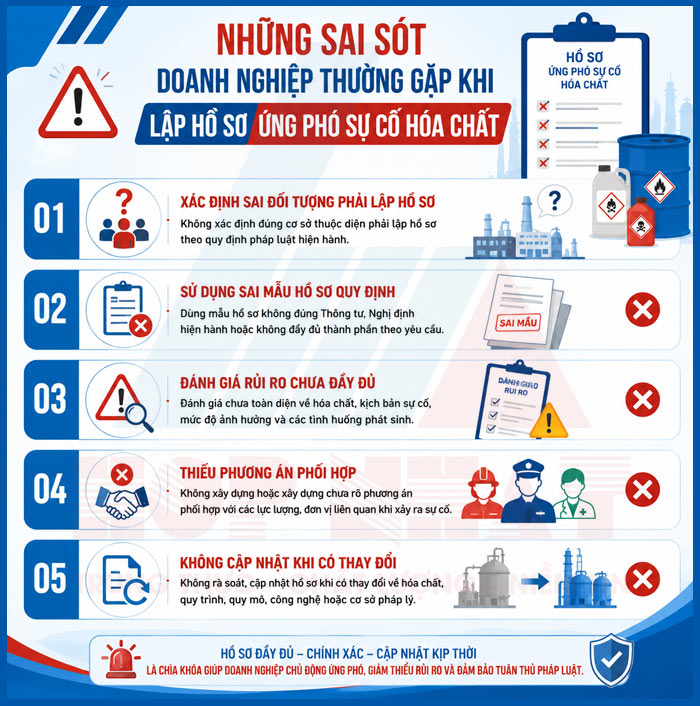
4. Common mistakes businesses make when preparing a chemical incident response dossier
In our consulting work, we see many businesses make common mistakes that require the dossier to be revised or cause it to fail the competent authority's requirements.
- Misjudging whether a dossier is required: Many businesses consider only the quantity of chemicals in use without comparing it against the maximum storage thresholds or the nature of their operations as defined by law.
- Using the wrong prescribed template: Many dossiers are copied from other facilities and do not accurately reflect the actual layout, production process, chemical types or operating conditions.
- Incomplete risk assessment: Developing only a few simple scenarios without fully considering risks such as chain reactions, fire spread, toxic gas releases or impacts on nearby residential areas can reduce the practical value of the dossier.
- Lack of a coordination plan: Some dossiers do not clearly define the role of on-site forces or the mechanism for coordinating with fire services, medical services, local authorities or specialized units when an incident occurs.
- Failing to update after changes: When a business expands its plant, adds new chemicals or changes its production process without reviewing and updating the dossier, the content may no longer reflect the actual situation.
5. Chemical incident response dossier services at Hop Nhat
Preparing a chemical incident prevention and response dossier is not just a legal compliance requirement; it also requires businesses to accurately assess risks, develop scenarios suited to their operating conditions and prepare sufficient emergency resources. This work calls for a combination of legal knowledge, chemical engineering, occupational safety, environmental expertise and practical production experience.
With experience advising many factories, warehouses and businesses in the chemical sector, Hop Nhat Environment provides chemical incident response dossier services in accordance with the Law on Chemicals No. 69/2025/QH15, Decree 25/2026/ND-CP and related guidance documents.

The service includes:
- Surveying the current condition of the factory, warehouses, production areas and chemical storage systems.
- Reviewing the chemical inventory, storage quantities and production technology to determine whether the business must prepare a Chemical Incident Prevention and Response Plan or Measures.
- Identifying hazard sources, assessing risk levels and developing appropriate incident scenarios.
- Preparing a complete dossier in accordance with current regulations.
- Supporting businesses in explaining and revising the dossier at the request of the competent authority (where appraisal is required).
We hope this article has helped businesses better understand 'Chemical incident response dossier services in accordance with regulations', what needs to be prepared and the practical benefits of a compliant dossier. Proactively identifying risks, developing response scenarios and preparing sufficient emergency resources helps businesses limit damage, protect workers, property and the environment, and keep production safe and stable.
Does your business need to determine whether it must prepare a Chemical Incident Prevention and Response Plan or Measures? Hop Nhat helps survey your site, review your chemical inventory and quantities, identify risks, develop incident scenarios, complete the dossier and revise it at the request of the competent authority. Call our Hotline 0938.857.768 now or Leave Your Details in the Consultation Form for advice on a chemical incident response dossier service that fits your business's actual operations.