Turnkey Environmental Compliance Services for Businesses
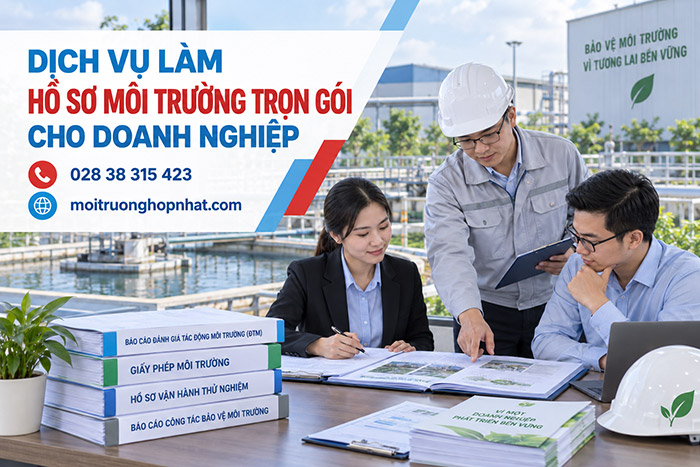
During investment and operation, businesses must ensure their environmental compliance documents are complete, submitted on time and consistent with actual operations. Hop Nhat's turnkey environmental compliance services for businesses are designed to provide end-to-end support, from reviewing the project and identifying the required procedures to preparing and finalizing the documents. With this unified process, businesses gain better control over timelines, reduce coordination pressure and keep legal requirements aligned with actual operations.
Article contents:
1. What are turnkey environmental compliance services?
Turnkey environmental compliance services support businesses through the entire process: reviewing current conditions, identifying the required environmental procedures, preparing and finalizing the documents, and following up and assisting during work with the competent authorities.
This solution lets businesses handle environmental procedures through a single, unified point of expertise, cutting the time spent researching procedures themselves and ensuring environmental matters are reviewed in line with the project's actual operating status. The consultant uses the project's actual information to determine its environmental obligations, develop an implementation plan and support the business throughout the documentation process.
Unlike simply preparing a set of documents to a given brief, the turnkey service starts with a comprehensive review of the business's legal status and current operations. This approach identifies the right issues from the outset and reduces the risk of missing documents, filing at the wrong time or making repeated revisions during the approval process.
Depending on the project, Hop Nhat's scope of service may include:
- Receiving and reviewing the legal information of the project or facility;
- Identifying the type of environmental compliance documents required;
- Advising on the list of documents the business needs to prepare;
- Surveying current production activities and environmental protection works;
- Compiling data on raw materials, capacity, wastewater, exhaust gas and waste;
- Preparing, reviewing and finalizing the documents;
- Supporting the business throughout the procedure;
- Revising, supplementing and providing explanations on the documents when requested;
- Advising on ongoing environmental obligations after the procedure is completed.
Hop Nhat's goal is not only to complete the documents but also to help businesses build consistency between environmental legal requirements, production activities and environmental protection works. This is an important foundation for businesses to manage environmental matters proactively throughout their operations.
2. Which environmental compliance documents does Hop Nhat prepare for businesses?
Depending on the type of production, project scale, capacity, location, waste sources and stage of operation, each business may need to complete one or more different environmental compliance documents. Hop Nhat therefore does not apply a one-size-fits-all package; instead, we review each project to identify the exact procedures required and develop a plan suited to the business's actual situation.
2.1. Environmental impact assessment (EIA) report
An environmental impact assessment report is required for projects subject to EIA under the regulations. It helps businesses identify impacts that may arise during construction and operation, and determine environmental protection works and measures appropriate to the project's scale, technology and characteristics.
2.2. Environmental permit
The environmental permit is a key procedure for projects and facilities that are required to obtain one under the regulations. When preparing the application, the business needs to clearly state its production capacity, sources of wastewater, exhaust gas and waste, treatment works and monitoring requirements, so that the application reflects actual operating conditions.
2.3. Environmental registration
Environmental registration applies to projects and facilities that fall under the cases required by regulations. The documents focus on the scale of operation, raw materials used, waste sources and environmental management measures, helping the facility establish all the information it needs during operation.
2.4. Environmental protection report
The environmental protection report reflects how the business has met environmental protection requirements during the reporting period. It typically compiles data on wastewater, exhaust gas, waste, monitoring results and the operating status of treatment works, helping the business maintain complete and consistent environmental records.
2.5. Chemical incident response documentation
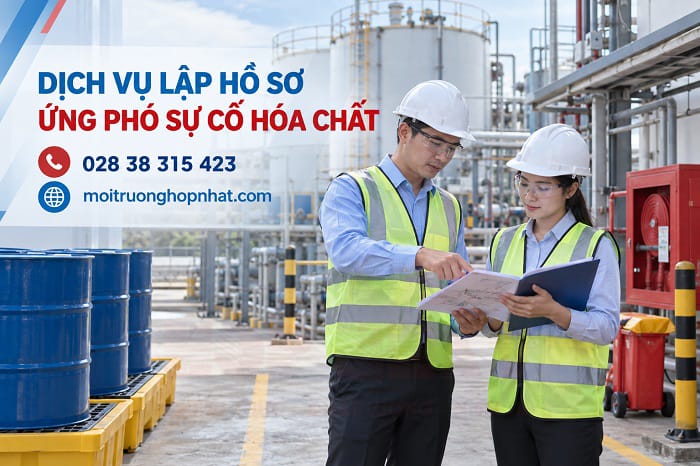
Chemical incident response documentation helps businesses proactively prevent, control and handle incidents that may occur during the production, storage, preservation and use of chemicals. Depending on the type of chemicals, stored quantities, scale of operation and characteristics of the facility, the business may need to complete procedures, plans or documents related to chemical incident response as required by regulations. Hop Nhat helps review current chemical use, identify incident risks and prepare documentation suited to the business's actual conditions.
2.6. Groundwater and surface water extraction and use documentation
Businesses that extract and use groundwater or surface water for production, business, services, agriculture or other purposes may need to register or apply for a permit, depending on the extraction volume, purpose of use and water source conditions. The documents must clearly specify the location of the extraction works, the water source, flow rate, purpose of use, extraction period and other relevant technical information. Hop Nhat helps businesses review their actual extraction needs, identify the appropriate procedure and prepare the documents in accordance with current regulations.
3. Hop Nhat's turnkey environmental compliance process
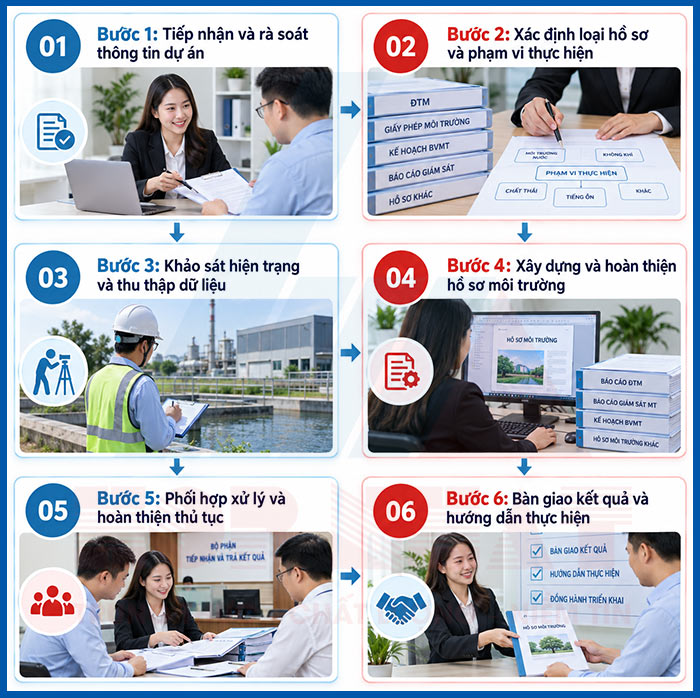
To get the documentation on the right track from the start, Hop Nhat follows a clear step-by-step process, from receiving information to handing over the results. Throughout the process, our specialists continuously cross-check legal information, production activities and environmental protection works to minimize inconsistencies that may surface when the documents are reviewed.
Step 1: Receive and review project information
Hop Nhat receives basic project information such as industry, location, area, capacity, production technology, raw materials used and operating status. If the business already has existing environmental compliance documents, our specialists review them at the same time to gain an overall picture before deciding on the implementation plan.
Step 2: Identify the type of documentation and scope of work
Based on the initial information, Hop Nhat analyzes the nature and scale of the project, waste sources and current legal status to determine the appropriate type of documentation. This review lets the business know exactly which procedures it needs, what the scope of work is and which documents to prepare before starting.
Step 3: Survey current conditions and collect data
For documentation that requires on-site verification, the Hop Nhat team surveys the factory, facility or project. The survey focuses on production lines, drainage systems, sources of wastewater and exhaust gas, waste storage areas and environmental protection works under construction or in operation.
The survey results are an important basis for cross-checking the documents provided by the business. As a result, the documentation more closely reflects reality and reduces the risk of inconsistencies between legal documents and actual conditions.
Step 4: Prepare and finalize the environmental compliance documents
After collecting all the data, Hop Nhat prepares the documents within the agreed scope. During this process, our specialists check the links between production scale, raw materials used, waste sources, treatment works and the corresponding environmental requirements.
If any information is inconsistent or the actual works do not match what is planned in the documents, Hop Nhat discusses with the business to agree on a solution. This approach avoids documents that are complete on paper but not feasible in practice.
Step 5: Coordinate and complete the procedure
Once the documents are finalized, Hop Nhat continues to support the business through the procedure within the agreed scope of service. If revisions, additions or explanations are requested, the responsible team coordinates to ensure the documents are fully and consistently updated.
Step 6: Hand over results and provide guidance
When the procedure is completed, Hop Nhat hands over the documents and advises the business on points to note during operation. For projects with ongoing obligations such as monitoring, periodic reporting, trial operation or management of treatment works, the business can continue to use Hop Nhat's professional services to maintain continuity in its environmental work.
4. Benefits of turnkey environmental compliance services
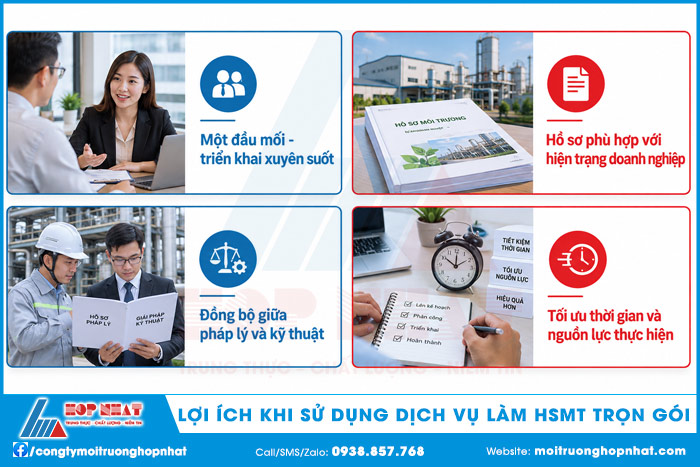
Choosing a single consultant for the entire process gives businesses better control over timelines, documentation quality and consistency between legal requirements and actual operations. With an integrated legal and technical approach, Hop Nhat helps businesses reduce coordination effort, avoid unnecessary extra work and manage environmental matters more proactively.
- One point of contact, end-to-end delivery: The business works with a single point of contact from information intake, identifying the document type and preparing the documents to coordinating the completion of the procedure. This reduces management time, minimizes information gaps and improves coordination between all parties.
- Documentation that matches the business's actual situation: The documents are prepared by cross-checking scale, capacity, production activities, waste sources, environmental protection works and existing legal documents. As a result, they are more consistent with the business's actual operating conditions.
- Legal and technical alignment: Expertise in environmental compliance, wastewater treatment, exhaust gas treatment, water supply treatment and system operation enables Hop Nhat to consider both legal requirements and the feasibility of technical solutions at the same time. This alignment helps minimize gaps between the documents and the actual works during implementation.
- Optimized time and resources: The process is organized into clear steps, helping businesses plan ahead, reduce the number of information requests and limit internal workload. This frees businesses to focus their resources on core business activities.
Hop Nhat's commitment
Hop Nhat values transparency, consistency and accountability throughout service delivery. Within the agreed scope of work, Hop Nhat commits to:
- Advising on the type of documentation suited to the characteristics and actual situation of each project;
- Carrying out the work within the agreed scope and timeline;
- Reviewing documentation for completeness, consistency and alignment with actual conditions;
- Coordinating explanations, revisions and additions to the documents within the scope of service;
- Being transparent about scope of work, timeline and costs;
- Supporting businesses with environmental needs that arise during investment and operation.
When environmental compliance documents are prepared methodically and consistently, businesses find it easier to invest, operate and expand production. With its turnkey environmental compliance services for businesses, Hop Nhat combines legal consulting capability with technical experience to ensure the documents are practical and suited to each project. This approach helps businesses maintain a close link between legal documents, production activities and environmental protection works.
If your business needs turnkey environmental compliance services, please contact Hotline: 0938.857.768 or submit your information via the Consultation Form so that Hop Nhat can review your actual needs. Our specialists will assess your existing documentation, identify the required procedures and propose an implementation roadmap suited to your project.