Exhaust Gas Treatment for Electronic Component Manufacturing
Electronic components are discrete electronic parts connected together in a circuit to form an electronic device. Before becoming finished products, electronic components go through a highly complex manufacturing process, with many stages generating wastewater and exhaust gas that pollute the environment. In the following content, join Hop Nhat Environment to learn about the characteristics of exhaust gas from electronic component manufacturing and how it is treated at a factory.
Article contents:
1. Sources of exhaust gas in electronic component manufacturing
Electronic component manufacturing is currently one of the most important industries in Vietnam's economy, accounting for about 18% of the entire industrial sector. Vietnam has been striving to demonstrate its potential as a "destination" for investors.
Electronic components fall into 3 basic types:
- Electromechanical components (components that provide a mechanical connection to the circuit, such as switches, fuses, quartz crystals, etc.)
- Active components (components that supply energy and deliver power into the circuit; examples include microwave tubes, phototubes, integrated circuits, diacs, diodes, etc.).
- Passive components (components that do not supply power to the circuit, i.e. they do not transfer energy into the circuit and only work when a power source is connected to an AC circuit; they include antennas, sensors, electromagnetic sensors, transducers, etc.).
Below is the manufacturing process for temperature sensors at a factory.
Raw materials > Inspection > Wire processing and soldering > Cleaning and drying > Visual inspection > Glue coating and drying > Assembly into tubes > Inspection > Finished products.
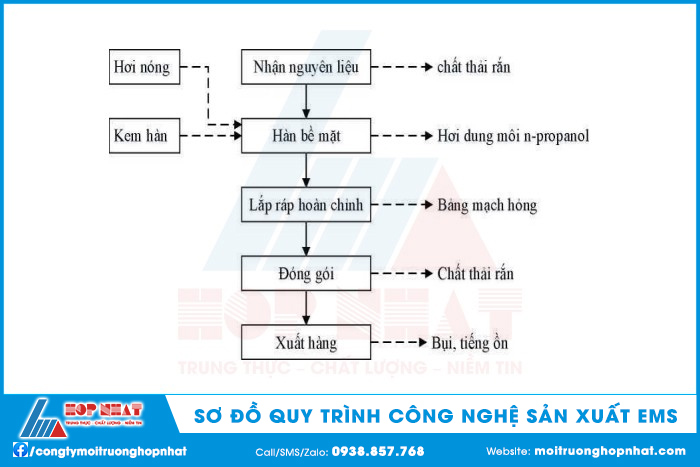
Input materials include cables, terminals and thermistors.
From the manufacturing process, the stages that generate exhaust gas are:
- Soldering;
- Cleaning;
- Glue coating;
- Drying.
2. Characteristics of exhaust gas from electronic component manufacturing
Pollutants in the exhaust gas are generated at the drying stage after glue coating, where:
- Epoxy adhesive contains: Bisphenol A (C15H16O2) 70%; CaCO3 25%; FeO 5%;
- Silicone adhesive contains: Polydimethylsiloxane 70%, CaCO3 10%, SiO2 20%
- The cleaning chemical is IPA alcohol, containing: 99.8% isopropyl alcohol ((CH3)2CHOH)
- SC-5000 cleaning chemical contains: 1,2-Dichloropropane (C3H6Cl2) 68%, Dichlorofluoroethane (C2H3Cl2F) 30%, Dichlorofluoroethanol 2%.
- In addition, there is total dust, silica-containing dust, CO, SO2, NOx, lead and its compounds, HF or organic fluorine compounds.
Pollutant concentrations at the drying stage after glue coating exceed the permitted standards and regulations. The factory therefore invested in an exhaust gas treatment system using adsorption (with activated carbon as the adsorbent) to treat the exhaust gas generated from soldering, cleaning, glue coating and drying.
3. Treatment method for exhaust gas from electronic component manufacturing
Each factory has a different exhaust gas flow rate and pollution level, so the process technology is also designed individually. Below is the exhaust gas treatment process at one factory for reference:
Process flow diagram: Exhaust gas > Suction hoods > Gas ducting system > Adsorption tower > Exhaust fan > Stack > Environment
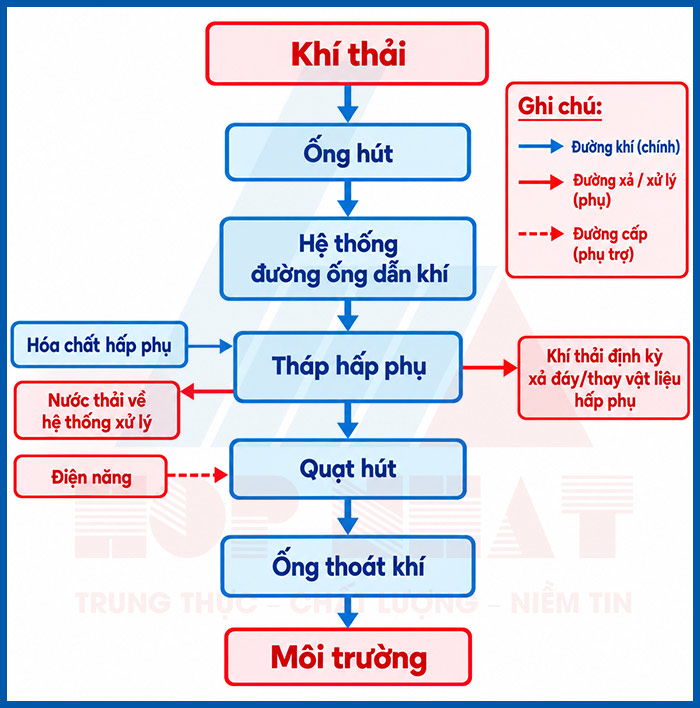
Process description:
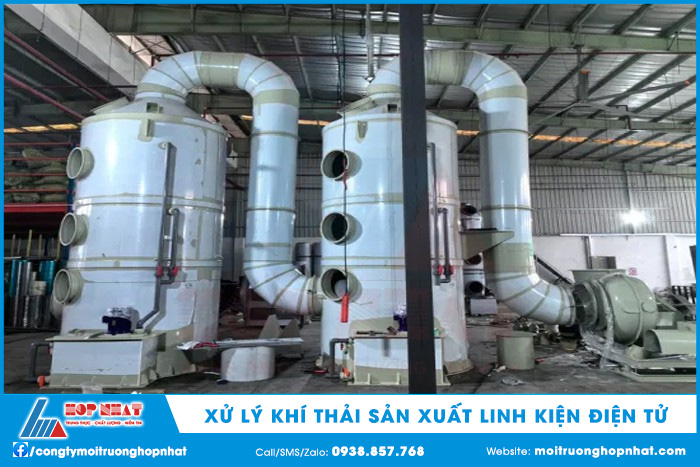
- Exhaust gas generated during soldering, cleaning, glue coating and drying is drawn through suction hoods mounted directly on the machines, via the exhaust ducting system under the pressure of the exhaust fan, and conveyed to the adsorption tower, where the pollutants in the gas stream are adsorbed.
- The treatment tower uses activated carbon as the adsorbent. In the adsorption tower, the gas stream moves horizontally through the activated carbon layers, where toxic gases are retained. The clean gas is discharged into the environment through the stack. The treatment system achieves an efficiency of 95–98%.
- The treated exhaust gas meets the applicable QCVN. The factory replaces the activated carbon every 3 months. The spent activated carbon is collected and treated as hazardous waste by a licensed contractor.
- Activated carbon is a fairly common adsorbent with the following basic characteristics: bulk density of 380–600 kg/m3, pore diameter of (20–40)×10⁻¹⁰ m, total pore volume of 0.6–0.8 cm3/g, and pore surface area of 500–1500 m2/g.
4. Consulting, design and construction of exhaust gas treatment systems for electronic components
Hop Nhat Environment provides consulting, design, construction and installation of exhaust gas treatment systems for electronic component factories. Depending on the production scale, exhaust gas flow rate and the composition of pollutants generated from soldering, cleaning, glue coating and drying, we propose a treatment solution suited to the actual conditions of each business.
Hop Nhat Environment's services include:
- Surveying current conditions, identifying emission sources and assessing exhaust gas characteristics at the factory.
- Advising on suitable treatment technology, such as activated carbon adsorption or a combination with other treatment methods when necessary.
- Designing the collection system, gas ducting, treatment equipment, exhaust fans and stacks.
- Construction, equipment installation and trial operation of the system upon completion.
- Inspecting, maintaining, renovating and upgrading existing exhaust gas treatment systems to meet production expansion needs.
- Consulting on related environmental issues and helping businesses check the consistency between the exhaust gas treatment system and their environmental compliance documents.
The above is some information about the characteristics and process of exhaust gas treatment for electronic component manufacturing at a manufacturing plant. Each factory has a different production scale and exhaust gas flow to be treated, so even for the same type of production, the process technology may differ from site to site.
With experience in environmental consulting and treatment, Hop Nhat Environment focuses on solutions that match each factory's emission characteristics, investment budget and operating requirements. Coordinating environmental compliance consulting with treatment system design from the outset also helps businesses avoid problems during actual implementation.
If your business needs consulting, design or construction of a new exhaust gas treatment system for electronic component manufacturing, please contact Zalo/Hotline: 0938.857.768 or leave your details in the consultation form for a site survey and a suitable proposal.